Sunday, February 26, 2012

Debut!

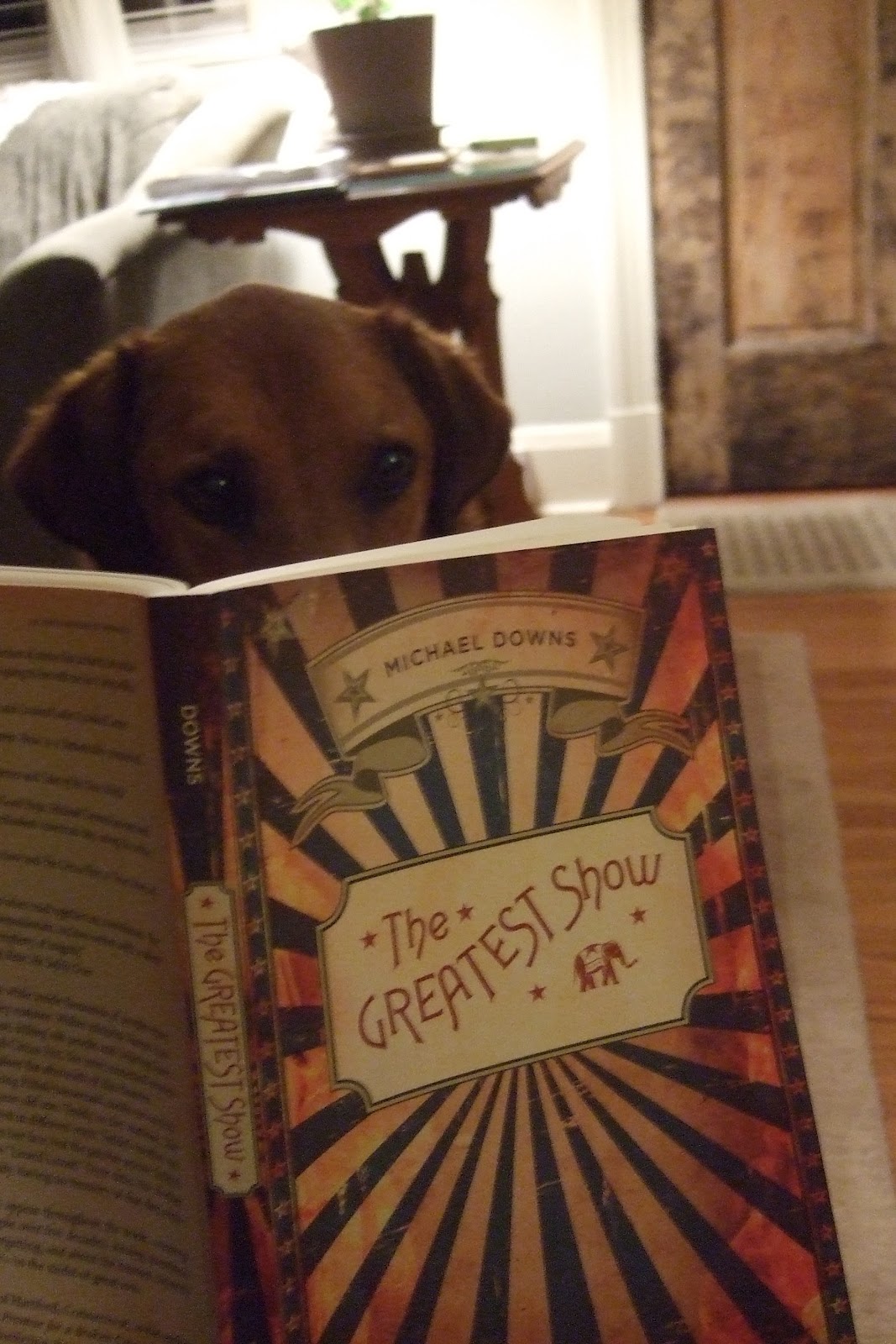
The Greatest Show makes its debut this coming week at a conference in Chicago. AWP will draw at least 9,300 writers, teachers of writing, and students of writing to hear writers speak on panels, to hear them read, and to buy their books at the book fair. It's astonishing to think that

1) There are that many writers and aspiring writers in these United States

2) That in reality there are way more than 9,300, because plenty aren't coming

3) That 9,300 of us are willing to travel to Chicago to hang out with fellow scribes. In winter. We kinda like each other, I guess.

Anyhoo, if you are among the multitudes, I'll sign copies of The Greatest Show at 3 p.m. on Friday, March 2, at LSU Press's table. Also on the LSU's docket: the amazing Pulitzer Prize-winning poet Claudia Emerson signs her newest volume, Secure the Shadow, and poet Alice Friman will sign her book, Vinculum.

Geaux LSU!

Saturday, February 18, 2012

The Cover that Drifted Away


Flying Alinga Flaming Ring, 2009,
smoke on paper, 60x40 inches

Two summers ago, I met an artist who paints circus scenes with smoke. Beautiful, haunting, dream-like. Rob Tarbell and I were both in residence at The Virginia Center for the Creative Arts, a farm in the mountains near Lynchburg where folks provided us and two dozen other artists with three squares a day, a comfortable dorm room, and a studio in a barn. “Knock yourselves out,” they told us. “Make art.”

Rob made his while protected by a hazmat suit. Like some bio-terrorism researcher, he’d step inside a tent-like contraption of shiny plastic and ductwork, and he’d affix a canvas overhead. In his hand was a stick, and clipped to the end of the stick was a photo negative or a credit card or some other material full of toxic chemicals. When he touched flame to the fuel, acrid, potent, deadly smoke rose to stain the canvas. A whiff was all it took. Any more and the canvas would start to look like the inside of a chimney.

When I first saw Rob’s art, The Greatest Show didn’t yet have a publisher. But already I envisioned his work on the cover. I asked, he said yes.

He calls the series of circus paintings, “Smoke Rings.” I love how he compares what he does with smoke to what animal trainers do with animals. Both take advantage of the natural tendencies of their subjects to have them do something unnatural. A horse will rear up on its back legs; but only a trainer can teach it to stay up there, balance, and then walk. Rob lets the smoke rise and stain, but he directs it to make pictures, something it wouldn’t ever do without him.

So, yeah. I was smitten. I still am.

But a cover isn’t art alone. It’s also marketing. Months after I met Rob, I read a New York Times piece about book-cover designs that publishers had rejected. Among the reasons, the Times informed me, were that some covers were too light. “White covers,” the story read, “don’t look good on Amazon.”

And I recalled those white backgrounds behind the smoky zebras.

Nevertheless, when my editor at LSU asked whether I had ideas for a cover I forwarded Rob’s work. “They are pretty cool illustrations,” I heard back, “and rather timeless and dreamy-looking—but not very colorful.”

So instead, LSU’s design editor created the beautiful, striking, haunting cover, which is art and also visible on Amazon, and more wondrous than I could have dreamed.

Still, I want people to see Rob’s smoke paintings and their ambiguous, otherworldly tension between childhood fantasies and danger, images that sear my Greatest Show self.

Alinga Trio with Anna Karma Fala, 2009, smoke on paper, 30x44 inches

"Later his dog met her cat, and it was a day before the cat would come out from under the house."

Ha ha. I like this story.

Saturday, January 21, 2012

My father didn't go to the circus


Edw. H. Downs, Age 3

On the day of the fire, July 6, 1944, Ed Downs (then called Ned) was three years old and his parents were already separated and on their way to divorce. My grandfather came by the house to pick up my father, planning an afternoon at the circus. He and my grandmother argued. Who knows the reason. You’re not taking him anywhere! she said.

Hundreds of people did go, though. One hundred sixty-eight died. Ned stayed home, missed out, survived, thank God.

Years later, my Irish great aunts would make the sign of the cross during family gatherings. They’d say, “Thank God that Ned didn’t go to the circus that day.”

That’s the family story. Perhaps the story is apocryphal. When last I mentioned it to my father, he said he didn’t remember hearing it. But I did hear it, years ago. He might have told me. Or maybe his brother did.

Someone must have told me that story. Because the story is the reason I made the main character in The Greatest Show a three-year-old boy when he and his mother go to the circus. That’s the age my father would have been had he gone. In my head, I sent another three-year-old boy in my father’s place. A famous writer I’ve heard speak has often instructed, “Don’t write about what happened in your family. Write about what you fear might have happened.” So when I sat down to write about the circus fire, I created a little boy named Teddy.

…[S]uddenly he’s toppling off the bleachers, falling through air, a little boy in summer shorts and shoes with laces knotted twice, plummeting through heat and the rush of air, too young even to imagine that there is something called death. On the ground his body won’t work anymore. Bits of straw tickle his nose. He can’t move. Heat like the most savage cold weighs on him, and the weight eats away his clothes, invades his skin and the skin under his skin. What’s worse is the fear, his trembling heart, the emerging awareness that his mother is not the world, and that the world hates him.

Ned Downs never made it to that circus. So I sent Teddy instead.

Thursday, December 29, 2011

Bóg dał, Bóg wziął


Bóg dał, Bóg wziął. That’s a Polish proverb, included on the dedication page for House of Good Hope, just beneath my grandparents’ names. It means “God gives, God takes.” Walt and Helen Petry both were dead by the time the book was published in 2007. Thus.

The phrase came to mind the day before Christmas when House of Good Hope’s publisher returned publication rights to me. This means the book is out of print and the publisher will make it no more. Theirs was a business decision I understood. It took four years to sell the first print run–a slow unraveling. The press offered to keep the book available in a single e-edition (via Barnes and Noble). I asked them to commit to full publication or give me back the rights, per our contract. The publisher’s terse reply arrived amidst a few holiday cards. “This letter will serve as official notice...” etc. I was disappointed that it had not begun, “Dear Michael.”

So now, HOGH has gone out of print just as The Greatest Show is poised to come into the world. Sad irony, that.

After I read the letter, I poured a nip of Scotch and toasted the book. Then I wandered room to room, as if the mail had brought news of the death of an old friend I once knew well but hadn’t talked with in a few years.

House of Good Hope was a necessary book for me to write. It wasn’t cut out to be a big seller, that I knew, but without it, I’d never have gotten my current job as a professor teaching creative writing. More importantly, I’d never have had friendships with the men who are the book’s primary characters. I made the book with the hope that it would honor the memory of my grandparents and give my family an historical record. Likewise, I wanted to create something Hiram, Eric, Derrick, Joshua, and Harvey could give their children to say, “This was your father once.” I wanted to write something that praised Hartford as a place worth our attention. I wanted to better understand why we leave places we love and what price is paid when we do.

All of that sounds like a eulogy, but it isn’t, because HOGH isn’t dead. The book has come home, its rights mine again to do with as I please. My literary agent encouraged this path. He mentioned the ease of creating a Kindle edition, how simple it is to create a print-on-demand copy. His agency could help. Why let the book languish?

So now, House of Good Hope is out of print and poised to return if I so choose. I can revise it if I want, or not, or update it, or not. Or maybe years from now another publisher will ask for it. Maybe it will just sit for a while, not languishing, but waiting, because how God gives and takes, and in what order, and how often, is always a mystery, and who knows what comes next?